Joe Meno's 10 favorite songs by Chicago bands

Joe Meno's 10 favorite songs by Chicago bands, Chicago Tribune. December 6, 2008

1. Naked Raygun "Wonder Beer": An existential rave-up from Chicago's legendary hardcore outfit. I can't hear it today without imagining the sound of clippers being used to shave someone's head.

2. Big Black "Bad Penny": Steve Albini's noise-core explosion still sounds frighteningly avant-garde.

3. REO Speedwagon "I Can't Fight this Feeling": The rumor was the drummer went to my high school: this is perfect music for pinning on a corsage.

4. Scotland Yard Gospel Choir "Tear Down the Opera House": This song mentions riding to work on the downtown Brown Line, with a massive chorus worthy of the Clash.

5. Cheap Trick "I Want You to Want Me": There is something about the live version of this song that outshines almost

every other live recording by anyone, ever: you can practically feel the crowd shoving you from behind, singing along.

6. Watchers: "Blik 'Em" -- Soul- and dub-inspired post-core with keyboards and handclaps. I have no idea what this song is about but I shout the words out loud every time anyway.

7. 1900s "Bring the Good Boys Home": An anti-war protest song more infectious than most radio pop hits.

8. Baby Teeth "Celebrity Wedding": Baby Teeth has more talent than any other working Chicago band at the moment: I

can't understand why they are not incredibly famous.

9. Coctails "Cadali": I don't know any other song that makes such effective use of a French horn; lush and absolutely brilliant mid-'90s art rock.

10. Vandermark 5 "Sthlm": If anyone thinks jazz is dead, they better listen to this song. Somehow Ken Vandermark instills this number with so much verve and rage, it makes most "rock" songs sound weak. There is one word to describe Ken Vandermark: genius.

It's Always Coke

Coca-Cola commercial, early 1994: The Coctails were hired through Wieden+Kennedy to appear in a Coca-Cola commercial aimed at making Coke feel current and connected to indie culture. We thought very seriously about whether to do it because we had seen bands like the Mighty Mighty Bosstones become identified with advertising, but Coke felt different to us — we genuinely liked Coke, its history, design, and old “It’s the Real Thing” commercials. They flew us to Los Angeles, put each of us in a suite on the Sunset Strip, drove us around in a stretch limo, paid for clothes and equipment, and filmed us performing live in front of a completely cast audience. We kept trying to work the old “It’s the Real Thing” jingle into the new Coke song, which apparently drove them crazy. The original idea of simply filming this quirky indie band gradually got buried under go-go dancers, surfers and other footage until we barely appeared in the final edit. The commercial never aired, which ultimately felt like a coup: we got paid roughly $30,000 without becoming “the Coke band.” We took some of the money personally but put a substantial amount back into the band, where it effectively fronted the production of subsequent Coctails records. The records themselves made money, so the Coke money became working capital for our DIY operation. It’s a good example of the strange position we sometimes occupied: we were attractive to mainstream media and corporations precisely because we were independent and outside that world, and occasionally we could let them borrow that identity while redirecting the resources back into what we were already doing. There was always something slightly absurd and subversive about imagining somebody in the middle of America watching ordinary television and suddenly having the Coctails appear in front of them: Who the hell are these guys?

Jonathan Demme, Jem Cohen

I was thinking about abrupt endings in writing, and that made me think about Jonathan Demme and Rachel Getting Married. There is a moment I remember where Robyn Hitchcock is outside playing, everybody is having a great time, the music is going, and then—boom—it just cuts to something else. No transition. Like a razor blade splice. I loved that.

Looking into it this morning, I found an interview with Hitchcock where he talked about being on set and how real the whole experience felt to him. He said his memory was basically of being at a real wedding, and called it “as real as it gets.”

That was exactly how I felt watching it. I remember telling Giselle that it didn’t feel like I was watching people pretend to be at a wedding. It felt like I was at the wedding. Even when people are giving speeches and everybody laughs, the laughter feels like they are hearing those things for the first time. They probably were.

I think this is part of why I’m suddenly thinking about filmmaking again. I watch the Criterion Channel all the time, and when they had the Jonathan Demme collection I finally had a chance to look at a bunch of his films together and really think about him as a filmmaker. Same with Jem Cohen and the way he approached music films like the Fugazi film Instrument. So much of that work feels like it is trying to find a way to let something actually happen in front of the camera. But also, these really dreamy things he did with Sparklehorse, Elliott Smith.

I was making films before the pandemic too, and again during my thesis. So maybe this isn’t really coming out of nowhere.

And it makes me wonder what a Coctails "film" could be, if there ever were one. Or Mudhead.

Maybe you just put four people in a room and create a situation where something might naturally happen.

Or not.

The Novelty of the Artifact

I used to think of Michelangelo’s David as kind of a cheeseball Art 101 thing. It had become so familiar through reproductions and pop culture that it almost had the quality of a refrigerator magnet. When G and I were in Italy, I didn’t even particularly want to wait in line to see it.

Then I saw it and it completely blew me away.

The opposite happened with Robert Frank. I love The Americans, and the Art Institute has original gelatin silver prints from it. Seeing those was exciting because they were the actual objects, but they didn’t really tell me anything I didn’t already know from reproductions, but it was the proximity to the artifact that was “neat.” Wow, he made this print in his darkroom. Cool.”

That seems useful to think about with an archive. Sometimes the physical object contains something the reproduction simply cannot give you. Other times, what you are experiencing is mostly the novelty of the artifact.

Maybe the question is not whether every original needs to survive, but what the original still knows that the reproduction doesn’t.

This comes out of the idea of a physical collective DIY place to house physical artifacts for DIY artists. It’s a great concept, but ludicrous when you think about it. Where would it go? Kansas? Seems right. In the middle of the country so everyone has to drive forever to see it, except for those who live in Kansas. Maybe it’s like an Air B&B. One in every town. Also problematic. So, how important really is the physical object?

The Institution and the Major Record Label

Thinking about the thing Archer said in the 1992 MTV piece. Don’t wait around for someone else to put out your record. Do it yourself and move on.
That was the DIY idea. Now, how do we do this ourselves when thinking of an archive, or some vessel to carry this stuff forward?
A digital archive as a website with an endowment to keep it active after we are gone is DIY.
But so much of our stuff needs to exist physically. That’s why it’s great that Pete is interested in taking some of our stuff. But not all of our stuff. Stuff that works within the framework of the collection there.
What is the alternative to the Institution? The major record label of archives? It doesn’t exist. If it did, what would it look like? How expensive would that be? How long would it last?

Illustrated Wikipedia

Last night I watched a documentary about the Zombies, and by the end I realized I had basically spent two hours watching an illustrated Wikipedia page. I learned things—I somehow never knew Rod Argent went on to form Argent—but I could have read most of it in ten minutes.

That feels useful to me in thinking about the Coctails film. I don't want to explain the band. The archive can do that.

What I want to get at is the stuff that doesn't fit very well into Wikipedia.

When I listen to “Abba Dabba Do Dance” and hear all of us laughing at the end, that's part of what made the Coctails wonderful to me. It's that thing that happens when the four of us are in a room together. Something slightly ridiculous and funny and completely natural that you couldn't really summarize as information. And why that song is stupidly simple and completely insane. How you have to count in your head to keep up with how many bars (12) the drums stay solo.

That's the thing I would like the film to somehow show. I guess I do want to share something with others on this. Mostly it’s just for me though. Research on this thing that happened so long ago.

Endowment for Continuity

I’ve thought about some version of this for a long time, although I don’t know that I ever had a phrase for it before: an endowment for continuity.

I don’t expect immortality. I don’t expect the things I’ve made, or the bands I’ve been in, to matter forever. I don’t think the Coctails need to be remembered forever. I don’t think Mudhead does. I certainly don’t think my own photographs or records or whatever else I’ve made need to somehow survive indefinitely.

That isn’t really what I’m after.

What I want is a buffer.

I want to know that when I die, all of this doesn’t immediately become a bunch of flat files full of random crap that somebody else has to figure out. I’ve seen enough old material now to know how quickly context disappears. You find something and know it matters, but maybe nobody remembers exactly what it was anymore, or where it happened, or why somebody saved it in the first place.

I would rather do as much of that work myself as I can.

And I think that’s partly what I’m doing with my personal Coctails archive right now. I’m creating a container for it. The timeline is a container. Mudhead can have a container too. My own work can have one. They don’t necessarily all need to become one gigantic archive with my name on it. I actually like the idea that they remain somewhat independent and overlap with other people’s archives.

Because that’s another thing I’m starting to understand.

Leo from the Human Observation Lab has all of these videotapes and recordings he made in Kansas City, including recordings of us, and he’s digitizing that material and it’s eventually going to the UMKC library. I’m finding that a lot of David Goodrich’s material is moving in that direction too.

I find that incredibly exciting.

These are people who were part of this scene when it was actually happening, and now, nearly forty years later, they’re trying to figure out how to carry the evidence of it forward. Not because anybody thinks everything needs to be immortalized, but because they have all this stuff and they know what it is. They know enough to understand that if they don’t do something with it now, eventually somebody else is going to be looking at it without that knowledge.

And I suddenly started thinking that maybe this is what that DIY scene is now.

We used to figure out how to put out our own records, book our own shows, make flyers, find places to play and get in a van and take all of it somewhere else. Nobody was waiting around for an institution to tell us how to do it.

Now some of the same people are sitting on thirty or forty years of recordings, videotapes, photographs and ephemera and trying to figure out how to preserve it.

Like Aadam Jacobs.

Maybe that’s that old scene now.

And I’m part of that now too.

One thing I’m particularly interested in with Leo’s material is the photographs. From what I can tell, most of the attention naturally goes toward the videotapes and recordings, because those are obviously important and they need to be digitized before the formats become even harder to deal with. But somewhere there are photographs too, and probably negatives.

That’s one place where I actually have something useful to contribute.

Rather than just asking somebody to send me JPEGs of old pictures, I’d love to help go back to the original negatives wherever possible and make really good archival scans. That’s something I know how to do. And if those images ultimately become part of an institutional collection, then there would be high-resolution files attached to them from the beginning rather than somebody someday trying to reconstruct them from an old Facebook post or a tiny scan somebody made twenty years ago.

That starts to make this feel less like me simply building my own archive and more like participating in a larger network of people doing the same thing.

Then there’s still this other thing I’ve been thinking about for myself, which I’ve been calling a foundation. Maybe that’s an overly grand word for it, but I actually kind of like it.

I don’t mean a foundation in the sense of creating some big organization devoted to promoting me or these other things after I’m dead. I’m thinking about something much more modest and practical. I’m trying to figure out whether there is some amount of my own money I can set aside so that when I die there is a person, or some simple mechanism, responsible for keeping the important domain names renewed and making sure the digital archive doesn’t just disappear because a credit card stopped working.

Maybe there are also physical things that haven’t found an institutional home yet, and there’s enough money for somebody to hang on to those for a while rather than having to make an immediate decision about them.

That might be all the foundation ever does.

I really like that idea.

It isn’t an attempt to dictate what happens to everything forever. If the University of Iowa wants part of something someday, great. If UMKC becomes the right home for something connected to Kansas City, great. Maybe some things stay distributed among different collections. Maybe something I think is important now turns out not to be important to anybody fifty years from now.

That’s okay.

What I don’t want is for the decision to be made accidentally.

I joined Mudhead when I was eighteen. I spent basically the first three years of my adult life in that band, which was really the entire life of the band. It was over by the time I turned twenty-one. I was playing in clubs before I was even old enough to drink in them.

That was 1987. Next month that will have been forty years ago.

It’s strange to even say that.

And now I’m looking backward and discovering that pieces of that time still exist because people saved them. Some of those people are now actively doing the work of making sure the material survives them.

I don’t know if Motley thought much about that while he was alive. Maybe he did. But it’s been really moving to discover how much of him remains because other people cared enough to preserve something.

And of course those people aren’t going to be here forever either.

There’s almost a second disappearance that happens when the people who remember what everything means disappear too.

So maybe this is the moment to do it.

I don’t have children who are automatically going to inherit all of this, and in some ways that makes the question clearer for me. I don’t want somebody someday opening drawers and boxes and hard drives and feeling this obligation to figure out what Barry wanted them to do with all of it.

I can make those decisions now.

I can decide what deserves a container. I can put enough context around it that somebody else has a chance of understanding it. I can help other people do the same thing when I have something useful to offer.

And then maybe I can leave behind just enough money to keep the lights on for a while.

An endowment for continuity.

Not immortality.

Just enough time for the next person to decide whether they want to carry it any farther.
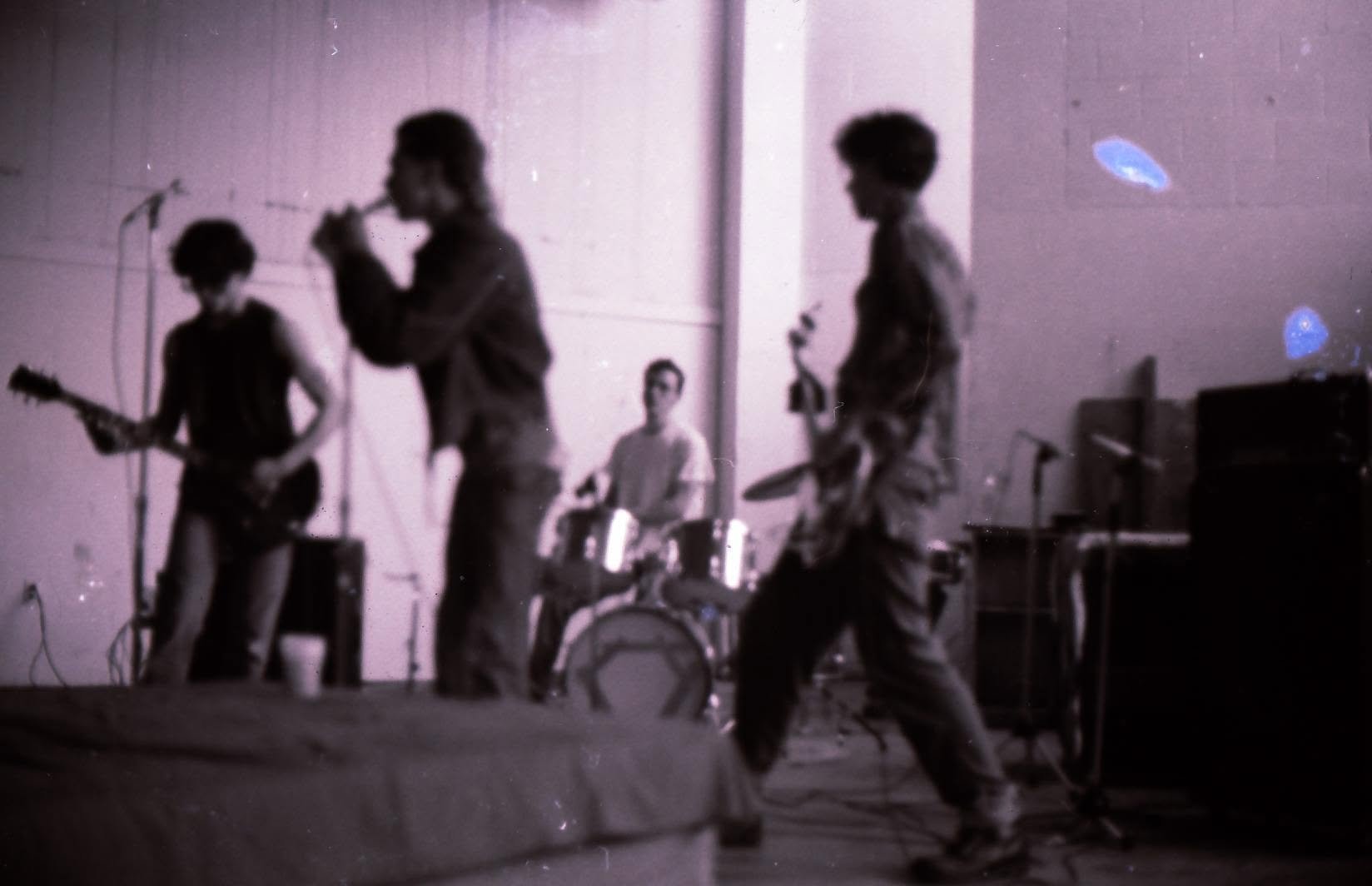
Working Notes. Random thoughts.

The Cancelled First Show / Proposal to Giselle

Date TBD — first show possibly Columbus or Akron

We started a tour, and I think the first show was supposed to be in Columbus or Akron. Somewhere on the way there we found out the show had been cancelled, so we just turned around and came back to Chicago.

I had been so busy getting ready to leave on tour that suddenly having a day or two with absolutely nothing to do was nice. They were unexpected free days. Giselle and I went to El Presidente restaurant, and I proposed to her there.

I didn’t have a ring yet. I bought her one when we got back from the tour.

Although somewhere on that tour I also bought her a Howdy Doody ring with a little horn on it. I can’t remember whether I actually thought of that as some kind of provisional engagement ring, or whether I just saw it and thought it was cool. That part is still a little fuzzy.

Also, John Upchurch says he has the Mudhead drum head and he’s not sure why. Looking forward to photographing it.

Mythology in Advance

One of the things I'm starting to think about this morning is the idea of mythology, because so much of the Coctails was about creating this Coctails mythology when we were young, and The Coctails Story that I (or we) wrote, which I am actually having trouble finding right now, was really about developing a mythology for a band that hadn't earned it yet. We hadn't been around long enough to have all these stories, so in some ways we were making the stories ourselves. And we knew no one believed the myths. It was part of us having fun. But now the mythology around the band, both by people who loved us, and my own mythologies, are genuine myth.

I was doing some research on Mudhead last night and came across people talking about Mudhead as maybe the greatest band that ever came out of Kansas City, which is kind of crazy for me to read. Maybe ten people think that. I don't know. It doesn't really matter. What interests me is that there are people who have carried that band around in their heads all these years and have some idea about what it meant, just like there are clearly people who have carried the Coctails around with them. You can see that on I Miss Lounge Ax all the time. People remember us. They miss us. They have photographs and flyers and stories, and they're trying to share those things in whatever way they can.

And then there is this other part of it that I'm only starting to understand, which is that the Coctails are becoming mythology to me too.

I've been reaching out to people lately, Irwin in particular, but also people connected to things like The Bert Boone incident, a piece I did in art school, and I'm realizing that some of these events that are monumental in my own memory are things the other person barely remembers, if they remember them at all. And that's okay. I'm actually starting to think that's part of what interests me about this. Something can have completely changed the direction of my life and, for the other person involved, maybe it was just something that happened.

Then last night I'm on Facebook looking through David Goodrich's photographs of Mudhead. David was married to Lori at one point, and I didn't even realize until last night that he died in 2014. His Facebook account is still there, maybe as a memorial page, and I'm downloading these photographs he made of Mudhead and wondering, where are the actual photographs? Where are the negatives? Does somebody have them? Did somebody know that they were worth keeping? Do they even exist anymore? It’s scary.

And that's another part of what I'm starting to get my finger around with all of this. Facebook can make it seem like something has been preserved because it's still sitting there where you can see it, but we don't own any of that. I can look at David's photographs right now, but that doesn't tell me where David's photographs actually are. Those downloaded images are like 94kb. Still, better than not having them at all, but I deal with archives everyday.

I think maybe this is why I'm doing this project the way I am. I'm not really trying to decide what any of it means yet, and I'm definitely not trying to prove that the Coctails were important. I'm just gathering information and trying to see what is there, and the closest thing I can compare it to is what I do when I go out and photograph in the landscape. I don't necessarily know what I'm looking for when I start. I notice something, I make a photograph, I keep moving, and sometimes it isn't until much later that I understand why I was interested in it in the first place.

That's probably what these working notes are too. I'm trying to gather the photographs and the flyers and the letters and ask people what they remember, and sometimes find out that they don't remember at all, and just keep all of that together long enough to see if it starts to mean something later.

When we were young we were creating the mythology in advance.

Now there actually is one, and I'm trying to figure out what it is.

Mudhead. The Foundry show with Slint? Is that me or Lori on the right?

But here's the thing with myths.

There is a Mudhead show at Volker Park that I have carried around in my head for almost forty years now. I think it was 1987, which means it was actually 39 years ago, which is fucking impossible, but apparently true.

In my memory, this is where I really saw Mudhead. They were playing outside in a park in the middle of the day, which already seems like such a non-Mudhead setting, and they completely blew me away. They seemed enormous to me. They sounded huge. I remember standing there thinking, Whoa. I didn't even particularly like that kind of music, whatever I thought that kind of music was at the time, but I loved them.

At the end of the set I walked up to Archer. I think I walked up to Archer because he was playing drums and was still there breaking things down, while everybody else had wandered off or was doing whatever they were doing. I told him how much I loved the band, and then I said something along the lines of, I know you guys are intentionally playing without a bass player and that's part of what makes you cool, but if you ever change your mind I'd love to audition.

And Archer basically said, Oh no, no, we're looking for a bass player. We just haven't found one yet.

That's part of my Mudhead mythology.

What happened next, at least as I remember it, is that I went to their next practice and auditioned, and they basically said, Yeah, you're great. And I remember Archer telling me that one of the bass lines I played was very McCartney-esque, meaning Paul McCartney, and my immediate thought was, I thought this was supposed to be a punk band.

That's the story I have carried around.

And maybe all of that happened exactly like that and maybe some of it didn't. At this point I don't even know that the distinction matters very much.

Because here's the strange part: the Volker Park show exists on video.

Leo Wetherill from the Human Observation Lab sent me a link to it. He had posted it online years ago, and suddenly there it was, this thing that had existed in my head for nearly forty years, actually moving in front of me.

And they seemed tiny.

Not literally tiny, obviously. But they looked like some young band playing in a park in the middle of the day. There are great little things in it. You can see Beth doing something to her guitar with what looks like a kitchen appliance, which is completely Mudhead. There are moments where I recognize the thing I remember.

But it doesn't look monumental.

It doesn't sound like giants.

And that really stopped me, because I think somewhere in the back of my mind I had assumed that if I could ever see that show again, the video would somehow confirm what I remembered. I would watch it and think, Yes, there it is. That's why I walked up to Archer afterward. That's why I wanted to be in this band. That's why this changed something for me.

But the video can't do that.

It only shows what the camera saw.

And maybe that's the thing I'm starting to understand about all of this. A document doesn't necessarily contain the experience. A photograph doesn't contain the experience. A video doesn't contain the experience. They can prove that something happened, or tell you who was standing where, or maybe settle some argument about whether Beth was using a kitchen appliance on her guitar, but they can't tell me what it felt like to be standing there at twenty years old watching Mudhead and thinking they were giants.

Was that show monumental?

Probably not to most of the people who were there.

It was monumental to me.

And nearly forty years later, I think that has to be allowed to be true too.

https://www.youtube.com/watch?v=MA3s1BEv-Z8

Hi. This is my first post

Giving this a try. I have a Discord server to communicate with Mark, John, and Archer about this archive and other possible ventures. The Discord is as messy as my mind right now, so let’s see if this works as an alternative. Perhaps this provisional site makes a better case for what this is and what it can be. Especially if “the guys” can comment on the posts.

Really behind on my business but very obsessed with getting some things digitized. Got that Coctails fire in the belly right now.

I feel part of this at the moment is about reconstructing memory into a visual representation, especially with images of the loft, and of our beloved Brocktoon. Really exciting to see photos I forgot about put concrete images to this fuzzy, dreamy memories.

The timeline helps solidify the memories. I see this as the backbone of the archive. Each timeline entry is a container that can hold as much or as little as we see fit. Three nights in Winnipeg? I could see that going either way :).

Finally, I decided to change the direction of this from something we may one day collectively publish to starting with what I have now, and what I can comfortably access through people I know. This takes the pressure off the guys to respond immediately to an overly excited me asking for things. The site will remain unpublished for now, but it gives me something concrete to show the guys and a few possible collaborators.

Instead of talking about what this can be, I decided to start showing what it can be. Put the materials inside the container and see how they look.